Hi, I’m Vishal Kumar, and welcome to ZeexasTech.com!
I’m passionate about technology, artificial intelligence, Microsoft Excel, and digital innovation. I created this platform to share useful information, easy-to-follow tutorials, and practical tips that anyone can understand and apply.
Whether you want to explore AI tools, improve your Excel skills, discover productivity tips, or stay updated with technology, ZeexasTech.com is here to help you learn something new and grow with confidence.
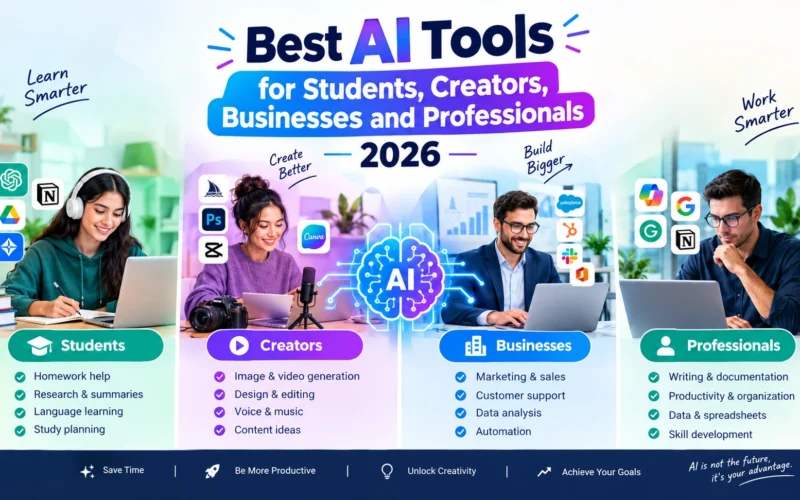
Artificial intelligence is transforming how people work, create content, manage businesses, and earn money online. In 2026, AI tools are no longer limited to technology experts or large companies. Students, freelancers, bloggers, entrepreneurs, marketers, and small business owners can use AI to complete everyday tasks faster and work more efficiently.
From writing articles and creating stunning graphics to editing videos, building websites, analyzing data, and automating business processes, the best AI tools can help you achieve more with less manual effort.
However, choosing the right tools can be challenging. Hundreds of AI applications are available, and each promises to improve productivity, save time, or help users grow their income. The key is to select tools that solve real problems rather than adding unnecessary complexity to your workflow.
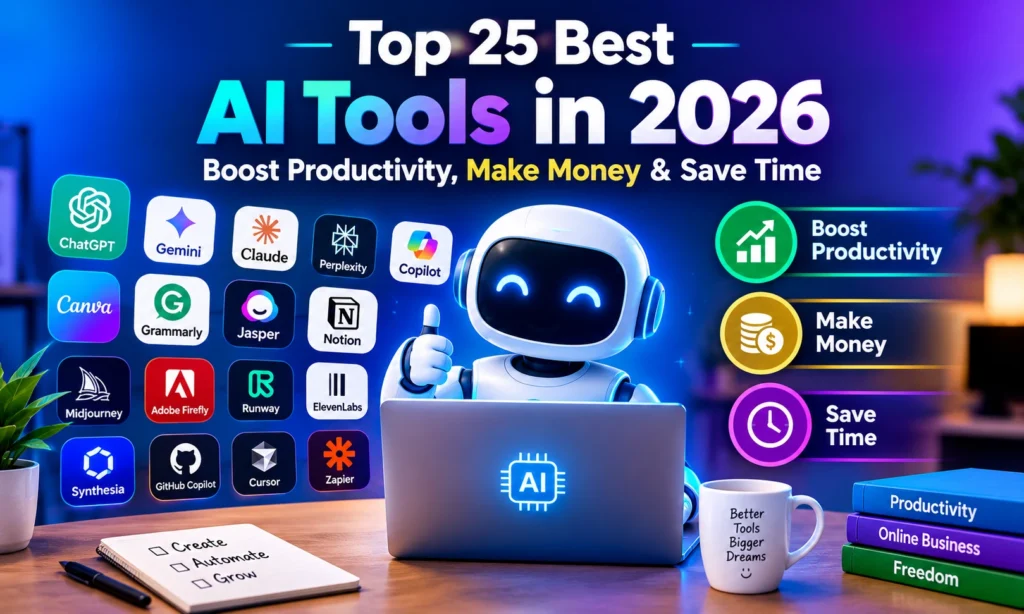
In this guide, we explore the 25 best AI tools in 2026 to boost productivity, make money, and save time. You will learn what each tool does, its main benefits, how to use it, and which types of users can benefit most.
Whether you want to start an online business, improve your content creation process, automate repetitive tasks, or become more productive at work, this list will help you choose the right AI tools for your goals.
Table of Contents
- What Are AI Tools?
- Benefits of Using AI Tools in 2026
- Top 25 Best AI Tools in 2026
- Best AI Tools for Making Money Online
- Best AI Tools for Productivity
- How to Choose the Right AI Tool
- Tips for Getting Better Results From AI
- Frequently Asked Questions
- Conclusion
What Are AI Tools?
AI tools are software applications that use artificial intelligence to perform or assist with tasks that traditionally require human effort. These tasks may include writing, research, image generation, video editing, coding, data analysis, customer support, and business automation.
Many modern AI tools use large language models, machine learning, computer vision, speech recognition, or generative AI to understand instructions and produce useful results.
For example, an AI writing assistant can help you draft a blog post, an AI image generator can create illustrations from text prompts, and an AI coding assistant can suggest code or help troubleshoot programming errors.
AI tools do not replace the need for human judgment. Instead, they can act as assistants that help people work faster, explore ideas, and reduce repetitive tasks.
Benefits of Using AI Tools in 2026
Before exploring the best AI applications, it is helpful to understand why these tools are becoming important for individuals and businesses.
1. Save Time on Repetitive Tasks
AI can assist with drafting emails, summarizing documents, organizing information, generating reports, and preparing content outlines. Tasks that once took hours may become much quicker when AI handles the first draft.
2. Improve Productivity
AI assistants can help you brainstorm ideas, prioritize tasks, analyze information, and organize projects. This allows you to spend more time on important decisions instead of routine work.
3. Create Content More Efficiently
Bloggers, marketers, YouTubers, and social media managers can use AI to generate content ideas, write initial drafts, design graphics, create video clips, and prepare promotional materials.
4. Start a Business With Fewer Resources
AI tools can help entrepreneurs research markets, create websites, prepare product descriptions, design advertisements, and automate customer communication. These capabilities can lower some startup costs, although running a successful business still requires planning and effort.
5. Develop New Skills
AI-powered learning assistants can explain complex concepts, generate practice exercises, review code, and help users learn unfamiliar subjects at their own pace.
6. Support Income-Generating Activities
Freelancers and creators can use AI to improve their services, produce deliverables more efficiently, and experiment with business ideas. However, AI does not guarantee income, and earning money still depends on customer demand, quality, marketing, and execution.
Top 25 Best AI Tools in 2026
The following tools cover different needs, including general productivity, writing, research, graphic design, video creation, coding, and automation. They are not ranked by a universal performance score; the best choice depends on your workflow and budget.
1. ChatGPT — Best AI Tool for Everyday Productivity
Best for: Writing, brainstorming, research assistance, learning, planning, and problem-solving.
ChatGPT is one of the most versatile AI assistants available. It can help users write articles, summarize information, prepare emails, explain complicated topics, analyze supported files, brainstorm business ideas, and create structured plans.
For example, a blogger can use ChatGPT to develop an article outline, generate headline variations, explain a technical concept, and prepare frequently asked questions. A freelancer can use it to draft proposals, organize client requirements, and create project checklists.
ChatGPT is also useful for learning new skills. You can ask it to explain concepts at different difficulty levels, provide examples, or guide you through a problem step by step.
How to use it effectively:
- Give clear instructions and explain your objective.
- Specify your audience, tone, and desired output.
- Provide relevant context or reference material.
- Review important facts before publishing or acting on the response.
How it can help you make money: Use it to support blogging, freelance writing, content planning, consulting, customer communication, or digital product development.
2. Claude — Best AI Tool for Long Documents and Writing
Best for: Document analysis, professional writing, coding assistance, and detailed reasoning.
Claude, developed by Anthropic, is an AI assistant that can help with complex writing tasks, document review, coding, brainstorming, and information analysis.
It can be particularly useful when you need to work with lengthy material, refine a report, compare documents, or improve the structure of a detailed article.
For example, a business owner can ask Claude to review a proposal for clarity, while a researcher can use it to organize notes and identify questions that require further investigation.
Claude can also assist with software development by explaining code, suggesting improvements, and helping debug errors. Certain features and integrations vary by plan and availability.
How to use it effectively:
- Upload supported documents when relevant.
- Explain what you want to extract or improve.
- Ask for specific changes instead of vague instructions.
- Verify important claims and technical recommendations.
How it can help you make money: Support writing services, document editing, business reports, coding projects, and content development.
3. Google Gemini — Best AI Tool for Google Workspace Users
Best for: Productivity, research assistance, writing, and Google ecosystem workflows.
Google Gemini is an AI assistant that helps users generate ideas, understand information, draft content, and work through everyday tasks.
It is especially worth considering if you already use Google products. Depending on your account, subscription, and available integrations, Gemini features can support workflows involving Gmail, Google Docs, Drive, and other Google services.
For example, a professional might use AI to draft an email, summarize a document, or prepare a first version of a presentation. A student can use it to explore a subject and create a study outline.
Gemini can also help with brainstorming, explanations, and coding-related questions.
How to use it effectively:
- Start with a clear task.
- Use available Google Workspace integrations where appropriate.
- Check generated information against reliable sources.
- Confirm which features are included in your account.
How it can help you make money: Improve productivity in virtual assistance, digital marketing, research, writing, and business administration.
4. Perplexity — Best AI Tool for Research
Best for: Web research, topic exploration, source discovery, and fact-checking.
Perplexity is an AI-powered search and research tool designed to help users investigate questions and discover relevant sources.
Instead of simply returning a list of search results, it can provide a synthesized response with links to sources. This can make early-stage research more convenient.
Bloggers can use Perplexity to explore a topic before writing an article. Students can discover relevant references, while business owners can investigate competitors, industries, and customer questions.
Nevertheless, citations do not automatically guarantee that every statement is accurate. Open the original source and confirm that it supports the claim being made.
How to use it effectively:
- Ask focused research questions.
- Request sources from authoritative websites.
- Compare multiple sources before drawing conclusions.
- Keep notes about facts that need additional verification.
How it can help you make money: Improve research for SEO articles, market analysis, educational content, and client reports.
5. Microsoft Copilot — Best AI Tool for Microsoft 365 Workflows
Best for: Office productivity, document preparation, spreadsheets, presentations, and workplace assistance.
Microsoft Copilot brings AI assistance into Microsoft’s product ecosystem. Depending on the version and license, it can help with writing, summarizing, analyzing information, and working with documents.
For example, an Excel user may benefit from AI assistance when exploring formulas, interpreting data, or understanding spreadsheet operations. A business professional may use Copilot features to prepare meeting summaries or develop presentation drafts.
Availability and capabilities differ between consumer Copilot, Microsoft 365 Copilot, and other Microsoft products, so check the specific version before subscribing.
How to use it effectively:
- Identify the exact Office task you want to complete.
- Provide clear instructions and relevant data.
- Review formulas, calculations, and generated documents.
- Follow your organization’s data protection policies.
How it can help you make money: Improve administrative services, spreadsheet work, reporting, presentation design, and virtual assistance.
6. Canva Magic Studio — Best AI Tool for Graphic Design
Best for: Social media graphics, presentations, marketing materials, thumbnails, and visual content.
Canva is a popular design platform that includes AI-powered features through Magic Studio. These features can help users create and edit visual content without needing advanced graphic design skills.
You can use Canva to develop social media posts, YouTube thumbnails, posters, presentations, advertisements, and promotional graphics. Its templates make it easier to maintain a consistent visual style across different projects.
For example, a small business owner can create a promotional campaign, while a blogger can design featured images for articles.
AI-assisted design features and usage limits may depend on your plan.
How to use it effectively:
- Start with a suitable template.
- Use AI features to explore layouts and visual ideas.
- Maintain consistent fonts, colors, and branding.
- Check image quality, text placement, and licensing requirements.
How it can help you make money: Offer social media design, presentation design, thumbnail creation, and marketing graphic services.
7. Grammarly — Best AI Tool for Writing Improvement
Best for: Grammar, spelling, clarity, tone, and professional communication.
Grammarly helps users improve written communication by identifying grammar problems, suggesting clearer wording, and assisting with tone.
It can be useful for students, professionals, bloggers, freelancers, and business owners who want their writing to appear polished and professional.
For example, a freelancer can review a client proposal, while a blogger can use writing suggestions to improve readability. AI writing features may also assist with drafting or rewriting content.
Grammarly should be treated as an editing assistant rather than an unquestionable authority. Suggestions can sometimes change the intended meaning or introduce unnecessary formality.
How to use it effectively:
- Review grammar and spelling.
- Improve unclear or overly long sentences.
- Match your tone to the intended audience.
- Preserve your own voice and meaning.
How it can help you make money: Support proofreading, editing, copywriting, and professional communication services.
8. Jasper — Best AI Tool for Marketing Content
Best for: Marketing copy, campaign planning, brand messaging, and business content.
Jasper is an AI platform focused on marketing and content workflows. It can help marketing teams create advertising copy, product descriptions, campaign drafts, and other brand-related materials.
For example, an online store may need several versions of a product description for different audiences. A marketer can use Jasper to generate initial variations and then refine them to fit the brand’s style.
AI-generated marketing content still needs review for accuracy, originality, brand consistency, and compliance with advertising rules.
How to use it effectively:
- Provide your target audience and campaign objective.
- Include brand guidelines and product details.
- Generate multiple variations.
- Test the final copy against real customer responses.
How it can help you make money: Support copywriting, marketing consulting, ecommerce content, and advertising services.
9. Notion AI — Best AI Tool for Notes and Project Management
Best for: Organizing projects, summarizing notes, managing knowledge, and documenting workflows.
Notion combines note-taking, databases, project management, and collaborative workspaces. Its AI capabilities can help users summarize information, draft documents, extract action items, and organize knowledge.
A freelancer might keep client briefs, deadlines, and meeting notes in one workspace. A content creator could maintain an editorial calendar and develop article outlines alongside research notes.
Notion AI is most valuable when you already use Notion to organize your work. Check current plan requirements for AI features.
How to use it effectively:
- Create a workspace for your projects.
- Store reusable templates and checklists.
- Summarize meeting notes into action items.
- Review generated summaries before assigning tasks.
How it can help you make money: Improve project coordination, virtual assistance, content management, and business operations.
10. Zapier — Best AI Tool for Workflow Automation
Best for: Connecting applications, reducing repetitive work, and automating business processes.
Zapier connects supported applications so that an event in one service can trigger an action in another. Its automation capabilities can help businesses streamline tasks without building every integration from scratch.
For example, a business might automatically send a notification when a new lead enters a spreadsheet. Another workflow could create a task when a customer submits a form.
AI-related features can help users build or enhance certain workflows, depending on the available plan and integrations.
How to use it effectively:
- Identify repetitive tasks.
- Choose a trigger and the actions that should follow.
- Test the workflow with sample data.
- Monitor errors and protect sensitive information.
How it can help you make money: Offer workflow setup, automation consulting, lead management, and small-business process optimization.
11. Make — Best AI Tool for Visual Automation
Best for: Multi-step workflows, application integrations, and complex automation.
Make is a visual automation platform that lets users connect applications and design workflows using a graphical interface.
It can be useful when a process involves several steps, conditions, or data transformations. For example, a workflow could receive a form submission, classify the request, save information to a database, and notify the appropriate team member.
AI can be incorporated into supported scenarios to help process text or classify information.
How to use it effectively:
- Map the existing business process.
- Build the workflow in small stages.
- Test unusual inputs and failure scenarios.
- Add monitoring so problems do not go unnoticed.
How it can help you make money: Create custom automation solutions for businesses, agencies, and online stores.
12. Midjourney — Best AI Tool for Artistic Images
Best for: Creative illustrations, concept art, visual experimentation, and image generation.
Midjourney is an AI image-generation platform that can create visuals from text prompts. It is useful for exploring artistic concepts, campaign imagery, mood boards, and stylized illustrations.
For example, a designer can explore several visual directions before creating a final campaign. A content creator can generate ideas for article illustrations or develop concepts for a digital product.
Generated images may require editing to meet exact branding or technical requirements.
How to use it effectively:
- Describe the subject and intended visual style.
- Specify composition, lighting, and mood.
- Experiment with different prompts.
- Inspect the final image for artifacts and usage restrictions.
How it can help you make money: Support illustration, concept development, creative services, and selected commercial design projects.
13. Adobe Firefly — Best AI Tool for Creative Editing
Best for: Image generation, design assistance, visual editing, and creative production.
Adobe Firefly provides generative AI capabilities for creative work. Depending on the product and feature, it can assist with generating images, creating visual variations, and editing assets.
It may be especially useful for designers who already use Adobe’s creative software and want to incorporate AI into an established workflow.
For example, a marketing designer could explore background variations or create visual concepts for an advertising campaign.
Always check the applicable commercial-use terms and the rights associated with uploaded or generated assets.
How to use it effectively:
- Define the purpose of the image.
- Generate several alternatives.
- Refine the strongest result.
- Review licensing and brand requirements before commercial use.
How it can help you make money: Support marketing design, image editing, creative production, and advertising projects.
14. Runway — Best AI Tool for Video Generation and Editing
Best for: AI video creation, visual effects, background changes, and creative video production.
Runway offers AI-powered video tools for creating and editing visual content. Its editing capabilities can help users transform footage using written instructions, including changing backgrounds, modifying visual elements, and adjusting the look of scenes.
These capabilities can reduce the effort involved in certain production tasks, although they do not eliminate the need for creative direction and quality control. See Runway’s current AI video editor for its available features.
How to use it effectively:
- Begin with a clear visual concept.
- Generate or upload suitable footage.
- Make targeted edits rather than changing everything at once.
- Review motion, continuity, and visual consistency.
How it can help you make money: Support promotional videos, social media content, creative advertising, and video production services.
15. Descript — Best AI Tool for Video and Podcast Editing
Best for: Podcast production, video editing, transcription, captions, and repurposing content.
Descript makes video and audio editing more accessible by allowing users to work with transcripts and text-based editing tools. It also offers AI-assisted features for removing filler words, improving audio, generating captions, and creating shorter clips.
For example, a YouTuber can turn a long recording into a polished video and several short clips. A podcaster can create transcripts and show notes without manually writing everything from scratch.
How to use it effectively:
- Import your recording.
- Generate and review the transcript.
- Remove unnecessary sections.
- Create captions and export the final content.
How it can help you make money: Offer podcast editing, short-form video production, transcription, and content repurposing services.
16. ElevenLabs — Best AI Tool for Voice Generation
Best for: AI narration, voiceovers, audio production, and supported speech applications.
ElevenLabs provides AI voice and audio-generation tools. These can help creators produce narration, generate speech from text, and develop audio content for supported use cases.
For example, an educational creator can prepare narration for a lesson, while a business can create voiceovers for product demonstrations.
Voice generation should be used responsibly. Obtain appropriate permission before cloning or imitating a real person’s voice, and follow applicable consent, disclosure, and licensing requirements.
How to use it effectively:
- Prepare a well-edited script.
- Choose an appropriate voice and speaking style.
- Review pronunciation and pacing.
- Check the rights and terms associated with your output.
How it can help you make money: Support narration, educational audio, video production, and authorized voiceover projects.
17. Synthesia — Best AI Tool for Training Videos
Best for: Business training, internal communication, educational videos, and presentations.
Synthesia helps users create videos featuring AI-generated presenters. It can be useful for organizations that need repeatable training material or multilingual presentations.
For example, a company can produce an onboarding video based on a script, while an instructor can prepare educational material for an online course.
AI presenters can reduce some filming requirements, but scripts and visuals still need careful review to ensure that the information is clear and accurate.
How to use it effectively:
- Write a concise script.
- Select a suitable presenter and visual layout.
- Add relevant supporting material.
- Review pronunciation, pacing, and factual accuracy.
How it can help you make money: Support corporate training production, educational content creation, and business video services.
18. HeyGen — Best AI Tool for Avatar Videos
Best for: Presenter-style videos, marketing content, localization, and video communication.
HeyGen provides tools for creating AI avatar videos and other AI-assisted video content. It can be useful when a business needs presenter-style communication without recording every version manually.
For example, a marketer can create a product explainer, while a training team can adapt approved material for different audiences.
Capabilities, languages, and usage limits depend on the current offering. Use realistic avatars and voice replication responsibly, with appropriate authorization.
How to use it effectively:
- Prepare a script that sounds natural when spoken.
- Select a suitable avatar and layout.
- Check pronunciation and lip synchronization.
- Review disclosures and consent requirements.
How it can help you make money: Support explainer videos, business presentations, marketing production, and localized video services.
19. GitHub Copilot — Best AI Tool for Programmers
Best for: Code completion, programming assistance, debugging, and software development.
GitHub Copilot helps developers write and understand code. It can provide code suggestions, explain programming concepts, and assist with changes across files through supported development environments and features.
Beginners can use it to learn programming concepts, while experienced developers can use it to reduce repetitive coding work.
However, AI-generated code may contain bugs, security problems, or incorrect assumptions. Developers should review the code, run tests, and follow secure development practices.
How to use it effectively:
- Describe the intended behavior.
- Provide relevant code and error messages.
- Review suggested changes.
- Run tests before merging or deploying.
How it can help you make money: Support web development, software projects, debugging services, and freelance programming.
20. Cursor — Best AI Tool for AI-Assisted Coding
Best for: Building applications, understanding codebases, editing multiple files, and debugging.
Cursor is an AI-focused code editor designed to assist developers within their coding environment. It can help users understand existing code, generate changes, and work through development tasks using natural-language instructions.
For example, a developer can ask for help implementing a feature or identifying the cause of an error. The tool can accelerate parts of development, but the developer remains responsible for architecture, testing, and security.
How to use it effectively:
- Open the relevant project.
- Explain the feature or problem clearly.
- Review proposed changes before accepting them.
- Test the application and inspect dependencies.
How it can help you make money: Support website development, custom applications, prototypes, and freelance software work.
21. Replit — Best AI Tool for Building Apps Quickly
Best for: Prototyping, learning to code, building websites, and developing applications.
Replit provides an online development environment with AI-assisted capabilities. It can help users move from an idea to an initial application without configuring a traditional development environment from scratch.
A beginner might experiment with a simple website, while a founder could create an early prototype for testing an idea.
A generated prototype is not automatically production-ready. Authentication, data protection, reliability, testing, and deployment settings still need attention.
How to use it effectively:
- Describe the application and its users.
- Build a small initial version.
- Test every important feature.
- Improve security and reliability before launch.
How it can help you make money: Support website creation, MVP development, internal tools, and small-business applications.
22. Surfer — Best AI Tool for SEO Content Optimization
Best for: On-page SEO, content planning, keyword coverage, and article optimization.
Surfer is an SEO-focused platform designed to help users evaluate and optimize website content. Depending on the available features, it can assist with content briefs, topic coverage, and on-page optimization.
Bloggers can use it to review whether an article covers relevant subtopics and answers important reader questions.
However, SEO success does not come from keyword density alone. Search intent, originality, useful information, technical performance, internal linking, and overall content quality also matter.
How to use it effectively:
- Research the target keyword and search intent.
- Develop a useful article outline.
- Cover the subject naturally and comprehensively.
- Review optimization suggestions without sacrificing readability.
How it can help you make money: Support SEO consulting, content optimization, blog management, and website growth services.
23. Writesonic — Best AI Tool for SEO and Content Marketing
Best for: Article drafts, marketing copy, SEO workflows, and content development.
Writesonic offers AI-powered writing and content marketing capabilities. Depending on the product and plan, it can help users develop article drafts, marketing material, and content ideas.
A blogger can use it to generate an outline, while a marketing professional can explore different approaches to a landing page or campaign.
The best results come from combining AI assistance with original expertise, trustworthy sources, and a clear editorial process.
How to use it effectively:
- Start with a specific content objective.
- Identify your target reader and keyword.
- Review factual claims and supporting sources.
- Edit the draft for originality and usefulness.
How it can help you make money: Support content writing, SEO services, ecommerce copy, and digital marketing.
24. Otter.ai — Best AI Tool for Meeting Notes
Best for: Meeting transcription, summaries, action items, and conversation review.
Otter.ai provides AI-powered transcription and meeting assistance. It can help users capture spoken discussions, review meeting content, and identify important points.
For example, a consultant can review a client meeting without manually transcribing every sentence. A team can use meeting summaries to keep track of decisions and follow-up tasks.
Transcription accuracy depends on audio quality, accents, background noise, and other factors. Participants should also be informed and appropriate consent obtained where required.
How to use it effectively:
- Use suitable audio equipment.
- Review names, figures, and important statements.
- Convert decisions into assigned tasks.
- Follow privacy and recording policies.
How it can help you make money: Support administrative services, meeting documentation, research assistance, and workflow coordination.
25. Amazon CodeWhisperer Alternatives and Modern AI Coding Assistants: Tabnine
Best for: Code completion, developer productivity, and supported team coding workflows.
Tabnine is an AI coding assistant that can help developers generate code suggestions, understand programming tasks, and work more efficiently within supported development environments.
It is worth considering for teams that want AI assistance integrated into their software development process. Organizations should evaluate its current privacy, deployment, security, and model options before choosing a plan.
As with any coding assistant, generated suggestions require human review and testing.
How to use it effectively:
- Install the supported editor integration.
- Configure the tool according to your team’s policies.
- Use suggestions for repetitive or well-defined coding tasks.
- Test code and review security implications before deployment.
How it can help you make money: Support software development, code maintenance, technical consulting, and programming services.
Best AI Tools for Making Money Online in 2026
AI tools can help you deliver services, build products, and manage business activities more efficiently. However, the right tool depends on the type of income-generating activity you want to pursue.
Here are five practical approaches.
1. Start a Blog or Content Website
Useful tools: ChatGPT, Claude, Perplexity, Surfer, and Canva.
You can use AI to brainstorm article ideas, research topics, organize outlines, prepare first drafts, and create featured images.
A sustainable blog still needs original insights, reliable information, useful content, and consistent publishing. Income may come from advertising, affiliate marketing, sponsorships, or products, but none of these methods guarantees earnings.
2. Offer Freelance Writing Services
Useful tools: ChatGPT, Claude, Grammarly, Jasper, and Writesonic.
Freelancers can use these tools to research assignments, prepare drafts, refine copy, and organize client projects.
To stand out, focus on a specific niche, understand the client’s audience, verify information, and deliver work that offers genuine value.
3. Create and Sell Digital Products
Useful tools: Canva, ChatGPT, Adobe Firefly, and Notion.
You could develop planners, templates, educational workbooks, presentation designs, or other digital resources.
AI can speed up brainstorming and design, but a successful product needs a clear purpose, quality control, suitable licensing, and a way to reach customers.
4. Offer Video Editing Services
Useful tools: Descript, Runway, ElevenLabs, Synthesia, and HeyGen.
Businesses and creators need videos for advertising, education, product demonstrations, and social media.
AI-assisted editing and voice generation can help you produce content more efficiently. Your competitive advantage will come from storytelling, editing judgment, communication, and reliable delivery.
5. Build Websites and Automation Solutions
Useful tools: Cursor, GitHub Copilot, Replit, Zapier, and Make.
You can learn to build websites, create prototypes, and automate repetitive business processes.
Start with simple projects, build a portfolio, and test solutions carefully before offering them to paying clients.
Important: Treat AI as a productivity advantage, not a promise of easy money. Choose a service people genuinely need and develop the skills required to deliver it well.
Best AI Tools for Productivity
If your main goal is to save time rather than generate income directly, begin with tools that address your most frequent tasks.
| Productivity need | Recommended tools | Main benefit |
|---|---|---|
| Everyday assistance | ChatGPT, Gemini | Brainstorming and task support |
| Long documents | Claude | Drafting and document analysis |
| Web research | Perplexity | Source discovery and research |
| Email and office tasks | Microsoft Copilot, Gemini | Workplace assistance |
| Notes and projects | Notion AI | Organization and documentation |
| Repetitive workflows | Zapier, Make | Process automation |
| Meetings | Otter.ai | Transcription and summaries |
| Writing quality | Grammarly | Editing and clarity |
| Visual content | Canva, Adobe Firefly | Faster creative production |
| Coding | Cursor, GitHub Copilot | Development assistance |
You do not need every tool on this list. Start with one or two that solve your biggest productivity problems, and add more only when they provide clear value.
How to Choose the Right AI Tool
Choosing the right AI application is easier when you evaluate it against your actual needs.
1. Identify Your Main Goal
First, decide what you want to accomplish.
Do you need to write content, create graphics, automate tasks, build software, or manage projects? Selecting tools by purpose prevents you from paying for features you rarely use.
2. Compare Free and Paid Plans
Many AI tools offer free access, trials, or limited usage. These options are useful for testing workflows before committing to a subscription.
Compare usage limits, available features, export options, collaboration capabilities, and monthly costs. A free plan may be sufficient for occasional work, while a paid plan may make sense for frequent professional use.
3. Evaluate Ease of Use
A powerful tool is not necessarily the best choice if it takes too much time to learn.
Beginners should look for clear interfaces, useful tutorials, templates, and straightforward workflows.
4. Check Privacy and Security
Avoid entering passwords, confidential customer information, private business documents, or sensitive personal data into an AI tool unless the service and your organization’s policies permit it.
Review privacy policies, data retention settings, access controls, and applicable terms before using AI for sensitive work.
5. Test Output Quality
Try a realistic task before choosing a tool.
For example, if you need an AI writing assistant, test it with a topic from your actual niche. If you need a video editor, use a short sample recording and evaluate the exported result.
6. Consider Integration With Your Existing Workflow
Tools that work with your current applications may save more time than standalone tools requiring manual copying and pasting.
Evaluate integrations with your email, spreadsheets, project management system, website, or content publishing platform.
Tips for Getting Better Results From AI Tools
Even excellent AI tools can produce disappointing results when instructions are vague. Use these practical techniques to improve your workflow.
Give Specific Instructions
Instead of asking, “Write an article about AI,” provide the subject, target audience, article structure, preferred tone, and desired outcome.
The more relevant context you provide, the easier it is to obtain a useful response.
Provide Examples
If you want a specific writing style, design direction, or report format, provide a sample. Explain which aspects you want the AI to follow.
Break Large Tasks Into Smaller Steps
For a blog post, separate research, outlining, drafting, fact-checking, editing, and SEO review. Reviewing each stage individually gives you more control over the final result.
Verify Important Information
AI can make mistakes, misunderstand instructions, or present outdated information. Check statistics, quotations, product features, prices, and legal or financial claims against reliable sources.
Maintain Human Oversight
Use your experience to improve the result. Add original examples, practical advice, and insights that generic AI-generated content may miss.
Measure the Time Saved
Track how long a task takes before and after introducing AI. If a tool adds complexity without improving quality or efficiency, consider a different approach.
Frequently Asked Questions (FAQs)
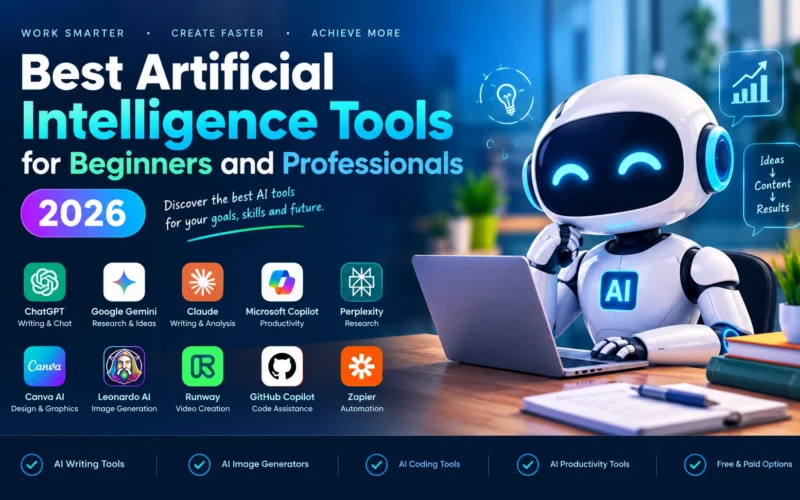
Some useful AI tools in 2026 include ChatGPT, Claude, Google Gemini, Perplexity, Canva, Microsoft Copilot, Notion AI, Zapier, Runway, Descript, and GitHub Copilot. The best option depends on whether you need writing assistance, research, design, automation, video production, or coding.
ChatGPT and Google Gemini are good starting points for general-purpose assistance. Canva is a practical choice for visual content, while Grammarly can help improve writing. Beginners should start with a simple tool that solves an immediate problem.
Yes. AI tools can help you deliver freelance services, create content, design graphics, build websites, edit videos, and automate business processes. However, earning money requires marketable skills, customer demand, quality work, and effective marketing.
Yes. Many AI platforms provide free plans or limited free usage. Availability, feature restrictions, and usage limits change over time, so review the official pricing page before choosing a tool.
ChatGPT and Claude are useful for brainstorming, outlining, drafting, and editing. Grammarly can help improve readability, while Perplexity can assist with source discovery. For SEO, tools such as Surfer may help evaluate content coverage.
Always verify claims and add original value before publishing.
Canva Magic Studio, Adobe Firefly, and Midjourney are useful options for different design needs. Canva is suitable for templates and marketing graphics, Firefly supports creative workflows, and Midjourney focuses on AI-generated imagery.
Runway, Descript, Synthesia, and HeyGen offer different video creation and editing capabilities. Descript is particularly useful for transcript-based editing, while Runway supports AI-assisted visual editing.
AI can automate or accelerate some tasks, but it does not eliminate the need for human judgment, domain expertise, communication, creativity, and accountability. Its impact varies by occupation and task.
Start with one to three tools that directly support your most important tasks. Expand your toolkit only when a new application provides a clear benefit.
AI-assisted articles can be useful when they provide accurate, original, relevant, and helpful information. Simply generating large amounts of generic content does not guarantee rankings. Focus on satisfying search intent, demonstrating expertise, and offering value to readers.
11. Is it safe to use AI tools for business?
AI can be useful for business, but safety depends on the application, settings, data involved, and intended use. Review privacy terms, verify outputs, protect confidential information, and maintain human oversight for important decisions.
12. What is the best AI tool for students?
ChatGPT, Gemini, Claude, and other educational tools can help students understand concepts, generate practice questions, summarize permitted materials, and organize study plans. Students should follow their institution’s academic integrity rules and verify the accuracy of AI-generated explanations.
Conclusion
The top 25 best AI tools in 2026 to boost productivity, make money, and save time offer practical ways to improve everyday work. From general-purpose assistants such as ChatGPT and Claude to creative platforms such as Canva and Runway, there are tools for nearly every stage of modern digital work.
For research, consider Perplexity. For project organization, explore Notion AI. For automation, compare Zapier and Make. For content creation, evaluate Canva, Descript, and other tools according to your needs. Developers can explore GitHub Copilot, Cursor, and Replit to accelerate parts of software development.
The smartest approach is not to use every AI application available. It is to identify your biggest challenge, choose a suitable tool, test it with real tasks, and measure the results.
If your goal is to earn money online, focus on solving real customer problems and building valuable skills. If your goal is productivity, prioritize tools that reduce repetitive work and improve the quality of your output.
AI is most effective when combined with human creativity, critical thinking, and consistent execution.
Start with one AI tool today, learn how to use it well, and gradually build a workflow that helps you work smarter in 2026 and beyond.

5 comments